How do I interpret the First Click Analysis in Tree Testing?
Table of contents
This section covers how to use the First Click analysis to:
View First Clicks per task
View First Clicks per task
This analysis displays First Clicks one task at a time.
Use the task selection dropdown list in the top section of the screen to switch to the task you want to analyze.
Alternatively, use the arrow buttons to the left and right of the dropdown list to move to the previous/next task.
For each task, First Click contains:
The task’s text and the correct answers.
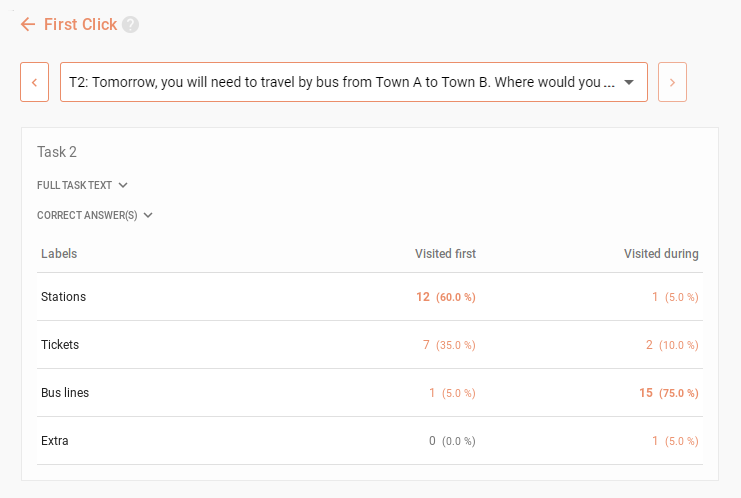
The First Click table contains in the following order: labels that were clicked by respondents first, the number of respondents who clicked them first (total + percentage), and the number of respondents who clicked them later (total + percentage).
By default, the first clicks are ordered by Visited first in descending order; however, the order can be changed by clicking the headers Visited first and Visited during.
The table is sorted by the column with an arrow in its header. Arrow down means descending order and arrow up means ascending order.
Click the value of Visited first to display a list of all respondents who clicked the chosen label first. To easily manipulate these respondents in the Respondents tab, click Add respondents to selection list.
First click analysis
This table provides data about the first clicks on all the labels on the top layer. Even though the task has a good score, here we can see that the labels Stations and Tickets attracted more respondents’ attention at first.
We need your consent to use cookies
on our website to provide you with the highest level of service.
You can change the settings by clicking the "Settings" button.
These cookies are necessary to ensure the operation and basic functions of the UXtweak website.
They store information about your UXtweak session and help protect your privacy.
Analytics cookies
These cookies are used to analyze traffic on our website, so that we can better understand our users
and improve the site's content, usability and functionality.